New Betahorn
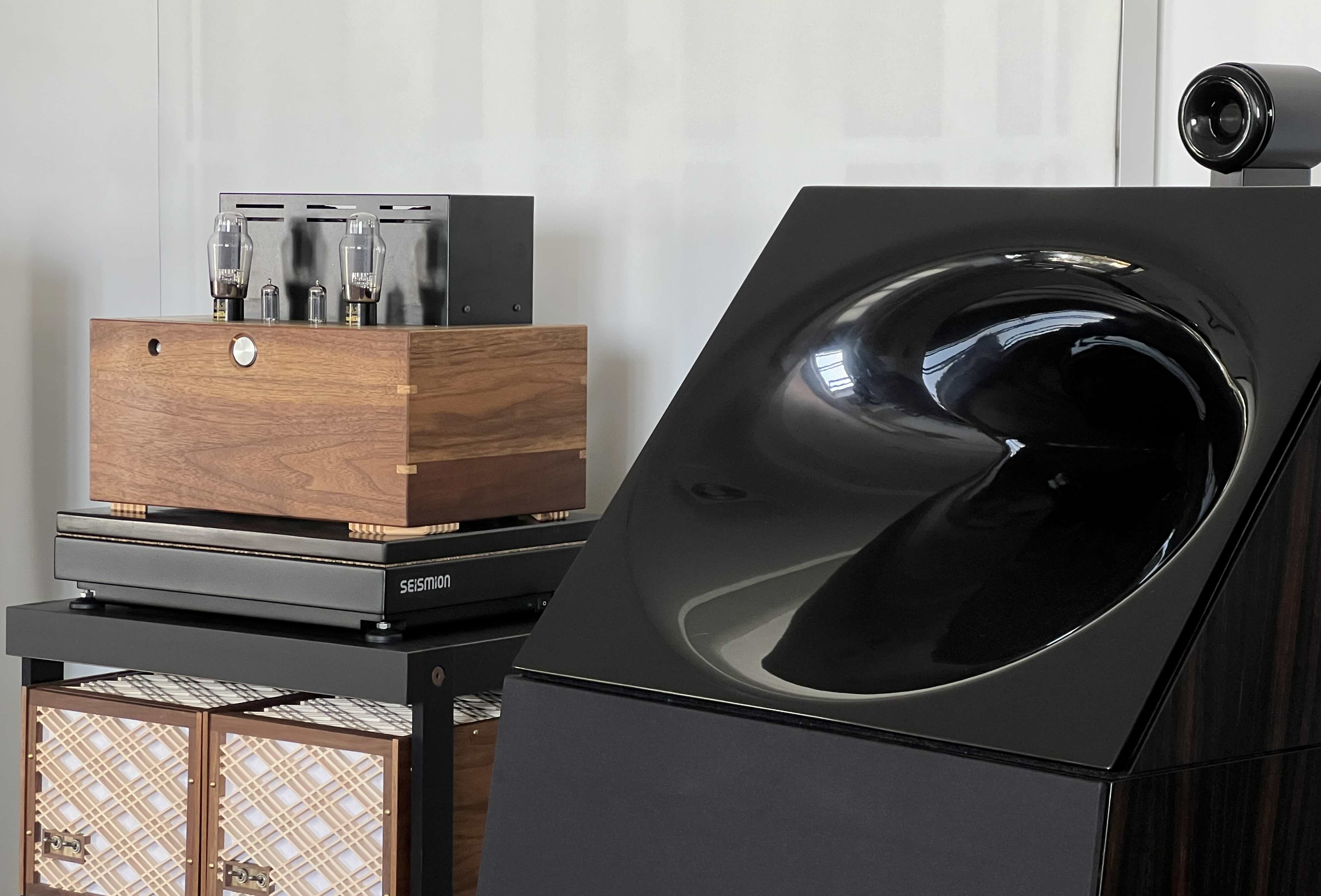
2020 it was time for a new version of the Betahorn.
Main improvement in the midrange, around the crossover (ca 480 Hz).
Due to now 3-way configuration, HF is cleaner at high SPL.
I really like the shape, and the midrange horn’s performance is as good as I can imagine (within the limits of physics) – so these are kept.
The previous version with frontloaded woofer has a steeper acoustical rolloff towards the midrange, the new version omits the basshorn and allows for my preferred time domain behavior, which needs a lower rolloff rate.
An unusually large vent area produces a very open sounding low-bass quality. While looking like an Onken cabinet (see the last picture with cloth cover removed), it is NOT. The ducts are short, which prevents standing wave problems, and provide high acoustical impedance (acoustical damping), for fast and musical bass.
Cabinet shape and dimensions remain (within a few mm) unchanged.
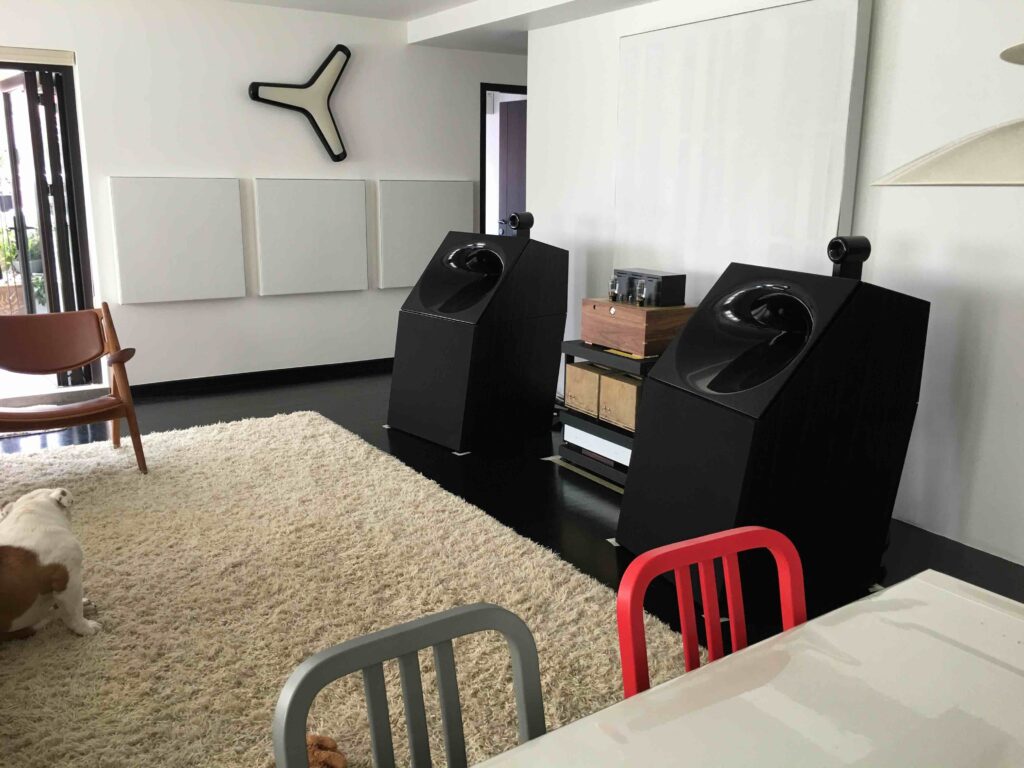
New Betahorns – dark version
This blog shows a special, high quality version of the new Betahorn, using a tightly matched pair of 16 ohms Altec 416 Alnico bass drivers, magnet mass-loading on all drivers, custom color horns, special wiring and crossover parts etc.
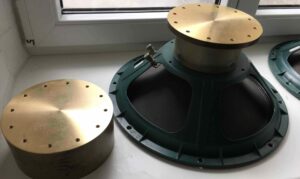
Vintage Altec 416 with magnet weight & adapter
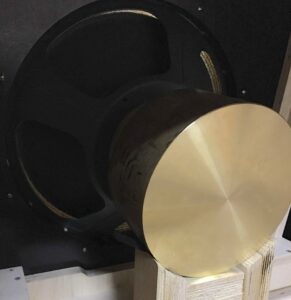
416 with weight & support
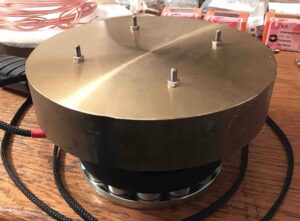
MF driver with magnet weight
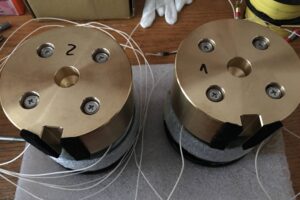
HF unit with magnet weight
Usually I offer to come to the listening room and tune the „crossover“ of my hornloudspeakers to adapt their sound to the room and user system. In this case we went even further and implemented a semi-active version, using solid state monoblocks for the woofers and a single-ended triode amplifier for the mid- and high frequency horns.
This crossover is implemented purely with passive parts, no additional active amplification or buffers are used.
The semi-active c/o allows for better equalisation in this room, which looses a lot of sub-100 Hz pressure due to the set-back corners (but also avoids some nasty LF resonances).
You can see the amplifiers in the rack in the middle between the loudspeakers, tubeamp on top, monoblocks below.
For best performace, the speakers are used without the magnetically attached cloth covers, as shown.
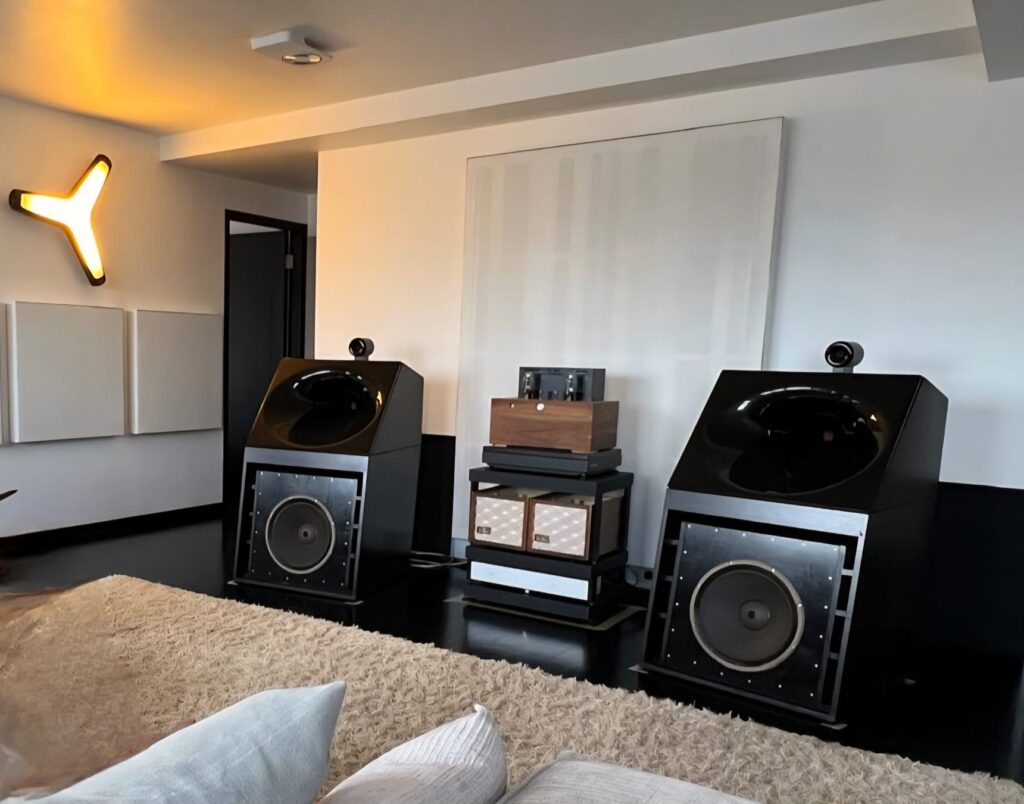
Betahorn with cloth cover removed, amps in the middle
6 Kommentare
Ng Kenneth · 12. August 2026 um 3:53
For many years, I struggled to achieve good sound from my audio system, largely because of the difficult room acoustics that David mentioned. I should also admit that I can be a rather demanding customer. I often challenged David to leave no stone unturned in the pursuit of better sound, and he has always risen to the challenge with patience and determination.
David addressed the room acoustics through a combination of acoustic treatment and passive equalisation incorporated into the crossover and the dedicated bass amplifier that he built for me.
Over time, his involvement grew to encompass much of the rest of my system. He built my phono stage and the power amplifier that drives the mid- and high-frequency sections of the Betahorns, and he is currently working on a preamplifier for me. With the exception of the solid-state bass amplifier, all the electronics David has built for my system are tube based.
Over the years, through his many visits here, David has also become a family friend, in addition to designing and building equipment for me.
With David’s help, I am finally getting the sound I have been striving for and, more importantly, I am simply enjoying the music.
Thank you, David, for your patience, dedication and, above all, your friendship.
Haigner · 17. August 2026 um 10:46
Dear Kenneth,
Coming from a world of musicians into one of physics & engineering, I walked a lonesome path. Starting with wide-band loudspeakers in the 80s, it took 10 years to arrive at satisfying time-domain solutions for multi-way concepts and another 2 years to build my own CNC router for exploring horn shapes in the 90s (while many believed that horns „shout“ and „color the sound“).
Development of acoustic treatment (that combines absorption and diffusion) and horn loudspeakers until they seem good enough to sell feels endless! Consider my patience well trained 😉
Some friends call me my own worst enemy.
Exploring the sound of solder & passive parts is essential to optimize passive crossover designs and, interestingly, helps to improve the sound of some tube amplifiers I use.
Last year’s 500+ capacitor survey (soldering connectors, 4 months „burn-in“ and countless listening hours to correlate measurements and sound characteristics) certainly added a new quality to my home-cooking.
I stick with loudspeakers and room acoustics, of course. Going over board with amp mods only for my personal use and to assist friends‘ DIY efforts. I do not develop circuits, just alter component quality.
Yet, people, not technical items, are my main motivation.
Hearing my father on the piano, led to 30 years of playing it myself.
Two friends + one professor + my boss at AVL nurtured my technical career.
Now it is you, together with the rest of my audio friends, who inspire me to continue.
Thank you for your kind invitation to experience exotic food & places like never before, getting to admire the way you two manage family along a massive workload, keeping me so well and allowing further explorations. You know I like challenges and I am very happy we reached a point at which we can together enjoy the Alpensymphonie as well as Spencers splendid DJ-ing with your exceptional hifi system.
It seemed like a long journey, but feels like a second compared to the decades of waiting for it.
Audrey Cheng · 17. August 2026 um 4:00
For as long as I have known Kenneth, he has always been passionate about audio reproduction. Thanks to David, he is finally satisfied!
At a recent house party we hosted, a DJ friend brought over his collection of records from the disco era, and we had a blast playing them at rather less-than-neighbourly levels, with the crowd dancing along. So I can safely say that this system is not just for audiophiles.
Haigner · 31. August 2026 um 20:21
Hello, Audrey. Thank you for taking the time to comment on my blog!
You made me feel like a VIP upon my visits – it was inspiring to enjoy your care and support so far from home. Especially, because I’m not much of a traveller.
As you have seen, it makes sense to tune a horn loudspeaker to the room, aligned with owner preferences. This is why I do not operate with dealers, who would struggle to provide such service without the speaker designers’s knowledge.
Producing an entertaining low end without compromising high resolution over the full audio spectrum is not easy (an overblown low end would boom and mask detail), but can be achieved with high quality gear. We managed to exploit the advantage of the room’s low-end peculiarity into an outstanding bass experience, which I am proud of.
Finally, I would like to mention 2 individuals without whom results would be minor:
Tim de Paravicini, whose phono- and linestage are (with ‚upgraded‘ parts) at the center of your music system. And Stephan Goetze, who provided one of his enormous power line filters to achieve this very refined sound despite your sometimes adventurous urban grid situation.
Both are dearly missed.
Allan Hyldal · 27. August 2026 um 9:58
Nice system! What tubes is used in the amplifier? And whar problems did you need to correct in the bas with crossover and was that the reason for going „active“ in the bas range?
How big is the midrange compressiondriver? Do you and a bigger backchamber to add more level at low frequencies, or how else is it possible to cross low order, that low in frequence where the compressiondriver is rolling off hard. Sorry for the many questions, you make so nice work David.
Haigner · 2. September 2026 um 18:35
Hello, Allan, nice to hear from you again. Sorry that I don’t go into technical details on my webpage. My customers hardly ask technical questions, besides room- and system compatibility.
The amp is an Elekit TU-8900, used with 2A3 output tubes. I helped out once it became clear Kenneth won’t have time to fully build the thing, and together we tried different caps in diverse positions. These finally became very large, so we added a frame below and around the original chassis to make room.
Room EQ: the wall behind the speakers lacks corners, on both sides. These corners usually reflect a lot of LF energy (which sometimes means a lot of trouble). Since Kenneth uses a preamplifier, we decided to bi-amp the speakers for ample headroom + some boost below 100 Hz.
The Beta midrange horn is 1.4 inch. Due to it’s low cutoff (and the „strange shape“) LF rolloff is gentle. This is the 3rd generation, and I guess my last one, technically no room for improvements. I once measured it with a TAD 2002 (wide range 1-inch HF driver) + custom adapter to see how it performs above 15 kHz, and found no difference to the simulated perfect horn, on- and off-axis. I am very happy with this horn.
Regards, David