Shh. Listening Bar
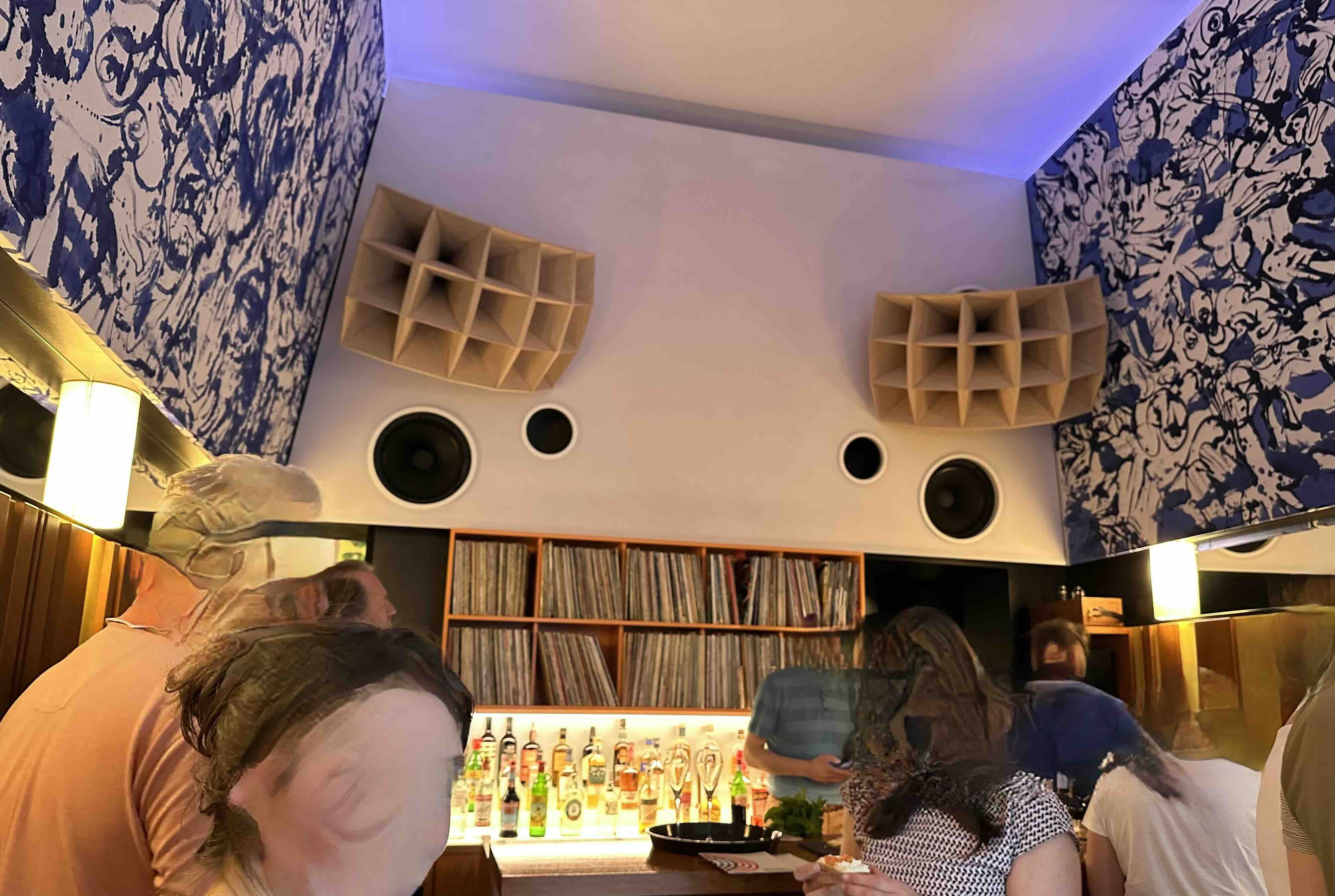
The idea: A small, purely analog (vinyl) listening bar with music in the foreground, where conversation shall remain at low level.
Problems: Regulations strictly limit the audio level to avoid trouble with neighbours. Conversation typically increases in loudness once the room fills and gets too noisy to understand each other, overpowering the music.
To avoid noise buildup in a crowded space, one could simply absorb as much sound as possible.
Reasons to choose a different path:
1) A totally absorbtive environment doesn’t feel good. Our eyes can see walls, but our ears cannot hear reflections. Our brain struggles to interpret this discrepancy, which feels uncomfortable and may lead to a „pressure-on-the-ear“ feeling.
2) Strong early reflexions help to increase speech intelligibility. Without them, we need to talk louder.
3) High absorbtion means higher loss of sound power over distance. In other words, the loudspeakers will be too loud at the bar and hard to hear further back in the room.
The concept: A synergetic combination of room acoustics, loudspeaker and amplification aims toward good speech intelligibility and clear music reproduction at low levels while keeping noise buildup under control
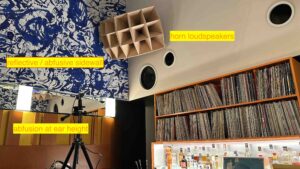
A) room acoustics:
– some early reflected sound energy is carefully distributed over the room while late reflections get absorbed to enhance clarity („quick soundfield“, RT between 0.3-0.35 s).
– to support speech recognition, abfusion (combination of absorbtion and diffusion) is used at ears height of the visitors. This produces reflexions for effortless communication, and provides just enough absorbtion to avoid the noise-buildup once the room fills with people.
– in the upper half of the room abfusion down to 30 hz, hidden behind fabric panels, works against low-mid frequency grunge, enhances clarity and keeps reverberation unter control.
– some sidewall areas at loudspeaker height remain reflective to support sound distribution into remote corners.
– absorbtion below the seatings (an absorbtive floor was out of discussion) „eats up“ some floor reflexions.
Careful balance of overall absorbtion and diffusion creates a relaxed atmosphere.
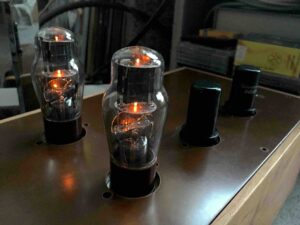
B) custom amplification: to avoid limiters (and other signal loss) a very low power (around 1 W per channel), single ended tube amplifier provides the signal for a pair of horn systems. Such amps sound particularly good at low levels. Amplifier power and loudspeaker sensitivity work together to keep loudness within regulations.
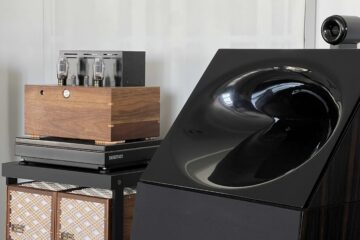
C) a pair of 3-way horn systems mounted above ear height distributes the sound nicely around the venue. The multicell midrange horn reduces forward output (due to interference between the individual cells) just enough to not blast away the first row of listeners.
Positioned high enough to reach back into the room.
Aimed downward, the horns direct their sound straight into the listener’s ears for high clarity at low levels.
High overall sound quality provides a satisfying experience even at low levels, down to 26 hz.
Since the room has high influence on the sound of the loudspeakers, they receive some fine-tuning after installation:
The passive crossovers (basically analog equalizers) are optimized via in-situ measurements and critical listening. A test setup with modular components allows quick comparisons.
Of course everybody wants nice bass. Deep, open, vibrant, rhythmically involving. I was allowed for some excess 🙂
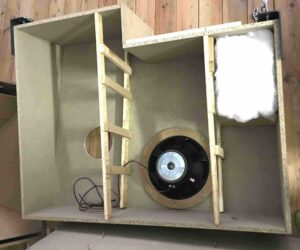
Real good low end means large woofer, port and volume – but the 500 liter bass cabinets had to be as flat as possible to save space.
This means trouble! Because width and height increase a lot -> internal reflexions interfere with driver output and can eliminate some frequency bands completely. Hence I simulated the shape to identify dominant modes:
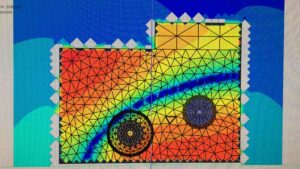
The carpenter delivered the particle-board cabinets with removable backpanels, to allow for installation of internal helmholtz absorbtion that eliminates the mode, plus some wideband absorbtion (not shown, I keep it at minimum) as well as additional bracing. A funny coincidence was that the weak 19 mm front panel together with the weight of the woofer initially vibrated in antiphase exactly at the tuning frequency of the bassreflex port – I measured no output from the port! Adding braces helped …
A measure of perceived clarity is Definition D50 – the early to total energy ratio as a percentage, using sound energy in the first 50 ms as the ‚early‘ part (https://www.roomeqwizard.com/help/help_en-GB/html/graph_clarity.html#top). 100% at all frequencies would be optimum. Measured results average as shown:
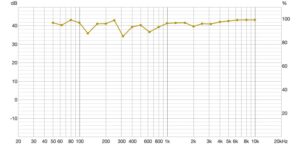
Nice! Especially for an empty room – once filled with people (absorbing reflexions from the hard floor) it should get even better.
I couldn’t implement all features of my regular horn systems, also the positions of the large multicell (well made by Markus Klug, https://klughoerner.com), the 15 inch LF drivers and the port ended up sligthly less than optimum (distances from floor, sidewalls and ceiling strongly influence behaviour), and yes, multicell sounds less clear & open than my own stuff – but the result is not too bad 😉
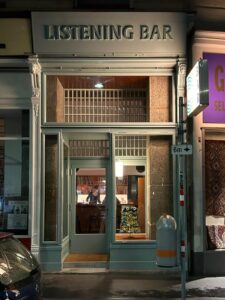
ps. sorry for the blurred faces of the nice people in the title picture – I just don’t know how else to de-identify. The listening bar doesn’t turn people into zombies.
Shh. Listening Bar
Wiedner Hauptstraße 18, 1040 Wien
https://www.instagram.com/shh_listening_bar
4 Kommentare
Didier Pilier · 15. Mai 2026 um 16:36
Danke für die kompakte Zusammenfassung und liebevoll-detaillierte Darstellung des audiotechnischen Konzepts, das sich hinter der Shh. Listening Bar verbirgt!
Haigner · 16. Mai 2026 um 12:00
Danke für den netten Kommentar, freut mich wenn’s gelesen wird!
Mein Dank geht freilich auch an die Auftraggeber und ihr Vertrauen, sowie
den Architekten der liebevoll und exakt umgesetzt hat was wir geplant haben.
Jörg MArkowitsch · 5. Juni 2026 um 10:43
Thanks so much for this great write-up.
To be honest, we were a bit sceptical at the beginning. What really convinced us was the idea that this should not be “just” a sound system, but a small concert room, with the whole system designed around the space itself. Looking back, that was absolutely the right decision.
The collaboration between Haigner, architect Alexander van der Donk, and Diklic carpentry was intense and at times quite demanding, but it was also clearly essential to the result. The listening session in the Haigner studio with the simulated setup already gave us a sense that this could become something special. Still, there was a lot of tension on our side until the first sound actually came out in the bar. That moment was pure relief and excitement.
Now, around one year later and after more than 80 DJs from Austria and abroad, we can say that the response from both DJs and listeners has been consistently enthusiastic. What has been especially striking is that DJs with very different styles all responded positively to the system. The sound quality has also become part of the identity of the bar itself. It is not just one feature among others — it shapes how the place is experienced.
One thing we learned very quickly is that this system does not forgive bad recordings — but when the recording is good, it reveals a level of detail, presence and quality that many people have never heard before. And the whole project also showed us how important it is to think about acoustics, room, furniture, kight and sound system as one integrated whole, not as separate elements.
For us, this project confirmed something we have seen in many other contexts as well: investing in real expertise may not be cheap, but in the end it pays off much more than spending money on expensive off-the-shelf components without the same level of thought, coordination and experience behind them.
We are very grateful for the care, knowledge and commitment that went into this project.
Haigner · 8. Juni 2026 um 12:01
Thank you, Jörg, for taking time to comment. While it was extensive, I enjoyed every moment of our collaboration. I am also happy to see so many people cherishing the result!